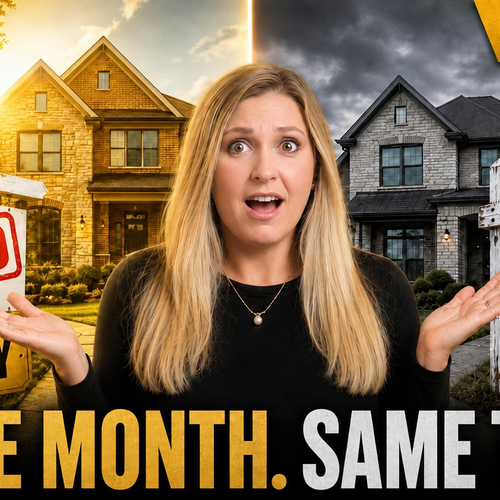
The Middle Disappeared From the Pfafftown Market Last Month. Here's What That Means for Your Home.
Every month I sort Pfafftown's closed sales by how long they took to sell. In July, for the first time since I started doing this, there was a hole in the middle of the data. Ten homes went under contract in twelve days or less. Seven took forty-seven days or more. In between two weeks and six weeks, the range where a healthy share of homes normally lands, there was nothing. Not one sale.
That gap is the story of the month, and it changes how you should think about selling a home here. If you'd rather watch than read, this month's video update is above. In this space, though, I want to go deeper into what the numbers actually show, because the written version lets me lay the evidence out piece by piece.
Market Snapshot: July 2026
Here's where Pfafftown stood at the end of July, with year-over-year comparisons where they matter:
- New listings: 22 (vs. 21 last July)
- Closed sales: 17 (vs. 16 last July)
- Median days on market: 12 (vs. 23 last July)
- Months of supply: 3.8 (vs. 3.4 last July); the 90-day average rose from 2.8 to 3.2 in a single month
- Rolling 12-month median price: $335,000, unchanged from last month and down about 2.6% year over year
- July sale prices: ranged from $242,000 to $1.3 million, with a $410,000 midpoint
Homes Sold in Pfafftown, NC — August 2026
Swipe left to view the full table on mobile.
| Address | Size | Closed Price |
| 141 Wellsprings Court | 7,303 | $1,300,000 |
| 5585 Salem View Road | 4,079 | $910,000 |
| 120 Town Lot Drive | 3,058 | $626,000 |
| 2188 Benwicke Drive | 2,930 | $505,000 |
| 4008 Highland Creek Court | 4,036 | $475,000 |
| 4921 Folkstone Court | 2,310 | $450,000 |
| 1053 Greenly Drive | 2,956 | $425,000 |
| 4381 Continental Drive | 1,600 | $425,000 |
| 3439 Transou Road | 1,833 | $415,900 |
| 5629 Stoneman Place | 2,407 | $410,000 |
| 4108 Rock hill Road | 1,661 | $369,900 |
| 4520 Chebar Drive | 2,263 | $344,999 |
| 3080 Gladewater Court | 1,805 | $330,000 |
| 5871 Crestlawn Court | 1,434 | $283,000 |
| 3725 Crestbrook Lane | 1,487 | $280,000 |
| 2186 Vienna Dozier Road | 1,108 | $279,500 |
| 5855 Woodsway Drive | 1,803 | $265,000 |
| 5908 Millstone Lane | 1,429 | $242,000 |
On the surface, several of those numbers look ordinary. Listings and closings were both up slightly from a year ago: steady, unremarkable, nothing unusual coming through the front door. The strangeness is entirely in what happened after homes hit the market, and that's where I want to spend most of this column.
A Market With Two Lanes and Nothing Between Them
Median days on market fell to 12, down from 23 last July. On its own, that sounds like straightforward good news for sellers, with homes selling nearly twice as fast. But a median only describes the typical home, and this month the typical home is hiding the real picture.
When I lined up all seventeen July sales by speed, they split cleanly into two groups. More than half, ten homes, went under contract in twelve days or less. Several sold in two or three days, and one in a single day. The remaining seven took at least forty-seven days, and some sat for four or five months. The entire middle of the distribution, from roughly two weeks to six weeks, was empty.
One month of data is one month of data, and seventeen sales is a small sample. I want to be honest about that. But this isn't a pattern that appeared out of nowhere. Last month I flagged early signs of a two-lane split and said I'd be watching whether it held. It didn't just hold. It hardened, to the point that the middle ground disappeared entirely.
Price Wasn't the Dividing Line
The natural assumption is that expensive homes sat and affordable homes flew. July's data says otherwise, and this is the part I most want homeowners to absorb.
The most expensive sale of the month, $1.3 million on Wellsprings Court, went under contract in 12 days. The least expensive, at $242,000, took 167 days. Five and a half months. If price point determined speed, those two results should have been reversed.
What the fast-lane homes actually shared, at every price point, were three things: they were prepared before listing, they showed well, and they were priced off current comparable sales rather than last year's. The slow-lane homes skipped at least one of those. That's my read of the data as someone working inside this market, and I want to label it as a professional observation rather than a statistic. It is, however, an observation the numbers support consistently, from the bottom of the price range to the top.
The behavior driving this is on the buyer side. Pfafftown buyers in this market are decisive. When a well-prepared, well-priced home appears, they move within days. When a home doesn't clear that bar, they don't circle it and negotiate slowly the way they might have a couple of years ago. They simply pass and wait for the next one. Pounce or pass, and that behavior is exactly what erases the middle of the days-on-market curve.
Faster and More Backed Up at the Same Time
Here's where July's numbers appear to contradict themselves, and where the two-lane framework earns its keep.
Homes sold nearly twice as fast as a year ago. Yet months of supply, the measure of how long it would take to sell everything currently listed at the current pace, rose to 3.8 months from 3.4 last July. More striking, the 90-day average jumped from 2.8 to 3.2 in a single month. A market that's speeding up shouldn't also be stacking up inventory.
Unless it's two markets. Fast-lane homes clear so quickly that they pull the median days on market down. Slow-lane homes don't sell at all in a given month; they just sit, and sitting inventory is what pushes supply figures up. The same split explains both numbers at once. There's no contradiction. There's a market where the average home increasingly doesn't exist.
For homeowners, the practical meaning of rising supply has changed too. In a normal market, 3.8 months of supply would suggest broadly softening conditions and gradually building buyer leverage. Here, that leverage is concentrated almost entirely in the slow lane. It isn't pressure on the whole market. It's pressure on the homes that missed their window.
Your Home Has Not Lost Value
With all the drama in how homes are selling, the what they're worth side of the ledger is genuinely calm, and I don't want the headline number to scare anyone.
The rolling 12-month median price sits at $335,000, flat from last month and down about 2.6% from last July. That year-over-year dip is a mix shift, not depreciation. Last year's cluster of high-end sales is aging out of the twelve-month calculation, which drags the median down even when individual home values hold steady. July's own sales ranged from $242,000 to $1.3 million with a $410,000 midpoint, a healthy spread with real activity at the top of the market.
The distinction matters because the two trends point in opposite directions emotionally. Days-on-market data looks turbulent; price data looks boring. Boring is the accurate read on values right now. What has changed in Pfafftown is not what homes are worth. It's the process by which they sell.
What This Market Actually Feels Like
If you're a seller, the most important thing to understand is that which lane your home lands in is largely decided before the sign goes in the yard. That's uncomfortable, because it means the outcome isn't something you can steer much once you're live; buyers render their verdict in the first days. But it's also empowering, because every one of the three factors that separated July's fast-lane homes (preparation, presentation, and pricing from current comps) is within a seller's control. Every home that got all three right last month, including the $1.3 million sale, went under contract in under two weeks. And because the middle lane is gone, the cost of skipping one of them is no longer a modestly longer wait. It's months on the market, and in most cases a price reduction before the eventual sale.
If you're a buyer, both lanes matter to you, and knowing which one you're looking at is half the battle. That slow-lane inventory represents real negotiating room. Sellers whose homes stumbled out of the gate are far more open to conversation on price, repairs, and terms than the supply headlines alone would tell you. But when a sharp, well-priced listing hits, you are competing with buyers who decide in days, not weeks. The old rhythm of seeing a home on Saturday and thinking about it until the following weekend will cost you the fast-lane homes every time.
For everyone else, the homeowners who aren't moving this year but like to know where they stand, the honest summary is that this is a stable market with an impatient personality. Values are holding. Activity is normal. But the tolerance buyers once had for homes that were almost right has, at least for now, gone to zero. I'll be watching closely to see whether the missing middle returns in August or whether this is the market's new shape.
Key Takeaways
- Pfafftown's July sales split into two extremes: ten homes went under contract in 12 days or less, seven took 47 days or more, and nothing sold in between.
- Price didn't determine the split. The month's most expensive sale was among the fastest, and its least expensive was the slowest.
- Homes selling faster and supply rising at the same time aren't a contradiction; they're two symptoms of the same two-lane market.
- Values are stable. The 12-month median of $335,000 was flat month over month, and the small year-over-year dip is a mix shift, not depreciation.
- Which lane a home lands in is largely decided before listing, through preparation, presentation, and pricing from current comparable sales.
A Final Word
If you're thinking about selling in the next year, the most useful thing you can do right now is find out, honestly, which lane your home would land in as it sits today and what it would take to move it to the fast one. That's a conversation specific to your home, your street, and your timeline, and it's one I'm glad to have with no pitch attached. If you're buying, I'm equally happy to help you tell the difference between a slow-lane opportunity and a fast-lane home that won't wait for you. Either way, reach out. I'll be back next month to tell you whether Pfafftown's missing middle stayed missing.
Check out this article next